
Ector Projected Versus Actual Release
TDCJ uses the exact term Projected Release Date. Its Classification and Records Office calculates that date for a sentenced state prisoner under the law that applies to the offense and sentence. The date is the expected exit from incarceration if parole does not occur sooner. It can change. Maximum Expiration Date is the calculated sentence endpoint, while parole or mandatory supervision can move a person into community supervision before that endpoint.
An actual release is a physical event recorded by the custody agency. Board approval, parole eligibility, a bond, or a court order may support a future exit, but each can leave more steps. A person may need to finish a program, clear a hold, await transport, or complete processing. A transfer to TDCJ, another county, federal custody, ICE, or an inpatient facility is an exit from one building without community release.
A pretrial detainee normally has no sentence-based release date. Bond, dismissal, plea, trial, a hold, or a later court order may govern that person. The Ector County court docket gives legal context, while Sheriff's release paperwork gives the county-jail exit time.
Find an Ector Release Date
First classify the custody. An Ector County Detention Center sentence and a TDCJ prison sentence use different calculations and records. The downtown Ector County Correctional Center may hold people for federal agencies, so county or TDCJ assumptions can fail there. The Youth Center follows confidential juvenile channels.
- Identify the present custodian from the jail, court, TDCJ, federal, or juvenile record.
- For TDCJ custody, search by TDCJ or SID number when possible, or use exact last name and first initial.
- Read the field labeled Projected Release Date and note when the record was checked.
- For a county jail sentence, ask ECSO and the clerk for the judgment, credit, holds, computation, and projected discharge.
- Near the date, confirm actual release or transfer with the custody agency and its release record.
The TDCJ inmate search asks for Last Name, First Name, TDCJ Number, SID Number, Gender, and Race. Minimum input is an exact last name with at least a first initial, a TDCJ number alone, or a SID number alone. TDCJ states that this search covers only people currently incarcerated in a TDCJ facility and that its data is at least 24 hours old and updated on working days.
No match cannot prove release. It may reflect discharge, transfer, another custody system, delay, or an identity mismatch. The Ector County release-record route connects the Sheriff, court, state, and federal channels when the live search is inconclusive.
For an Ector County court case, use the Tyler court portal to identify the case and read available docket entries. A judgment may state the sentence and jail credit. A bond order, dismissal, modification, revocation, or commitment entry may change the expected path. Free access does not include every document image, so request the named judgment or order from the correct clerk when the docket entry alone is not enough.
TDCJ Ector Release Date Records
While a person is incarcerated, the TDCJ record may show location, offenses, and Projected Release Date. The official definition page explains that the date is calculated under offense and date-specific rules. Mandatory-supervision eligibility, Board action, flat time, good conduct time, maximum expiration, and earlier parole can all affect it.
The TDCJ definition of Projected Release Date is captured in the image below.
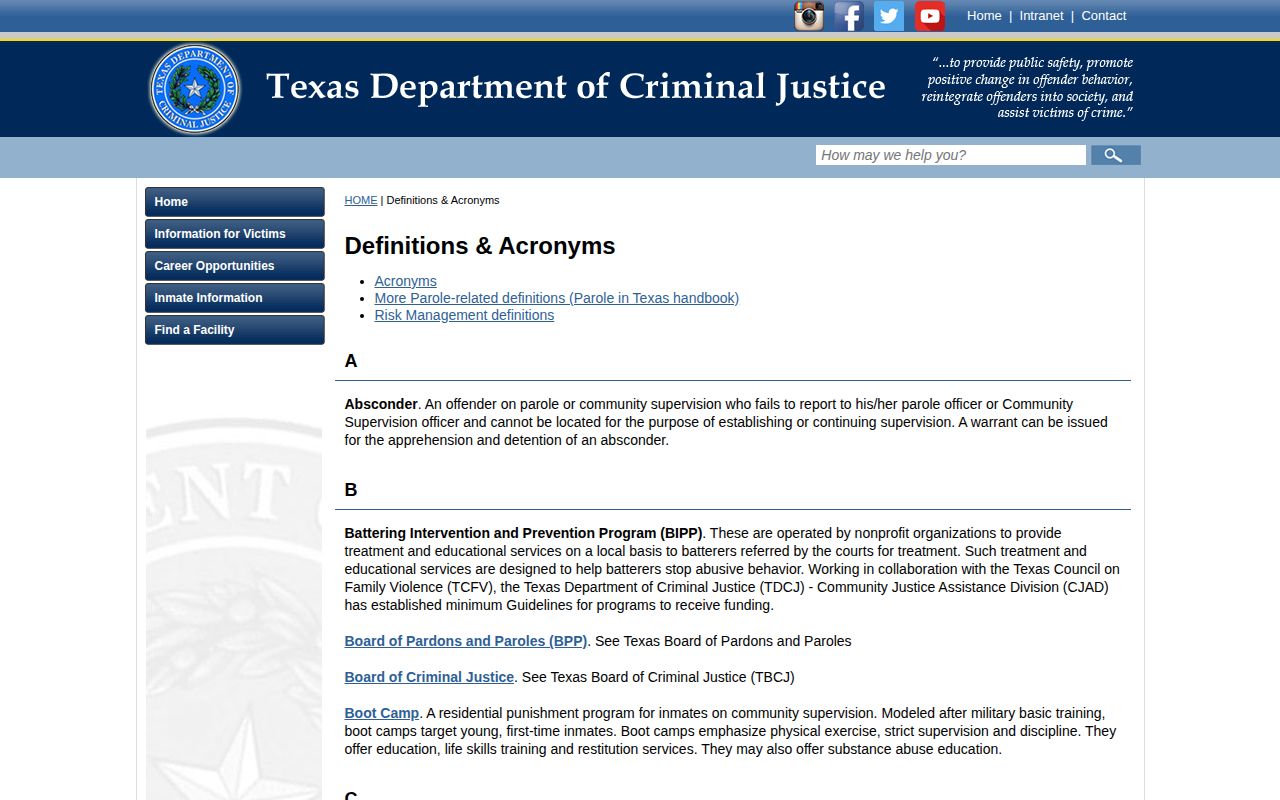
The definition makes the limit clear: the field is an agency calculation, not a promise that the person will walk out on that date.
After release, the public inmate search is not a lasting released-person archive. TDCJ's no-charge email route at pia@tdcj.texas.gov can return incarceration history and a projected date. Send the full name and seven-digit TDCJ number. Without that number, provide exact date of birth, or approximate age and county of conviction, and place the name in the subject. Ask separately for actual release information when that is the goal.
The TDCJ email information page lists the available incarceration and projected-date fields.
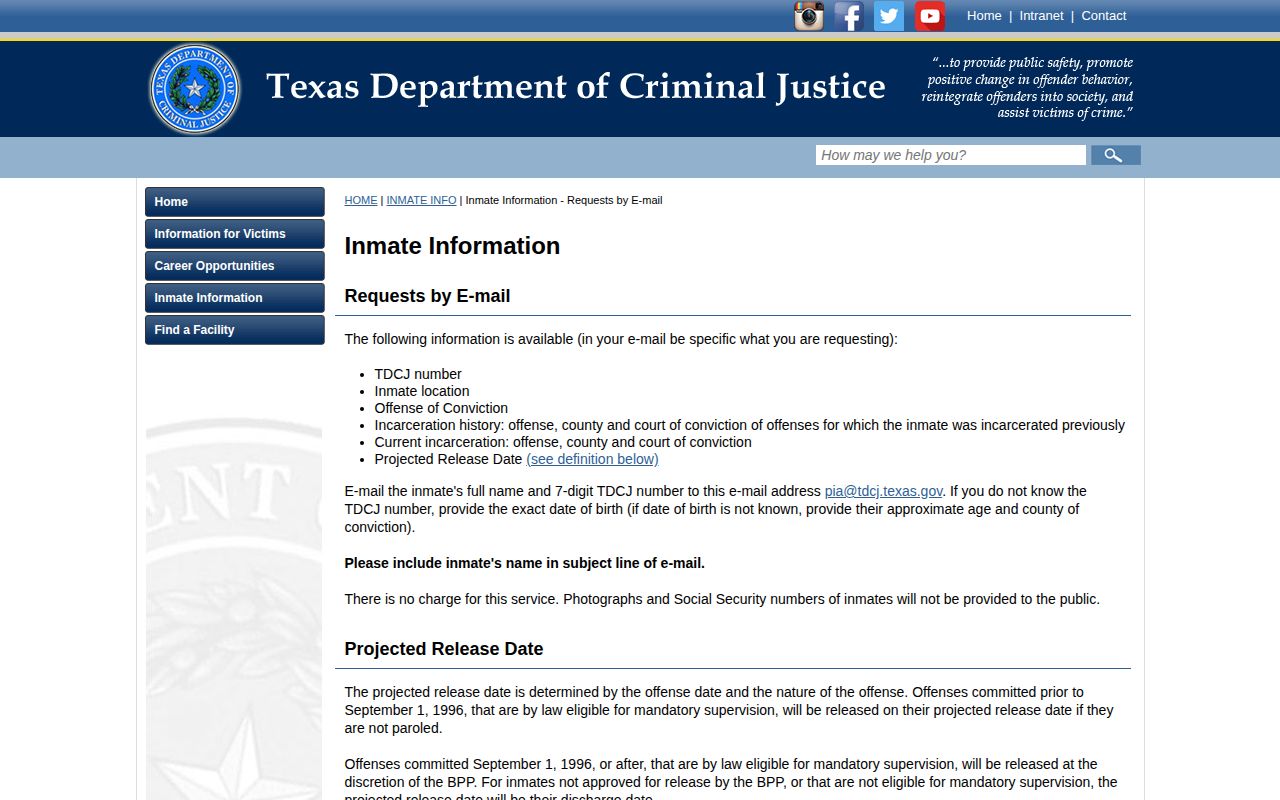
This channel is useful after a current online profile disappears, but certified or fuller history may require a formal TDCJ Public Information Act request.
Texas Good Time for Ector Releases
Texas Government Code Sections 498.002 through 498.004 govern TDCJ good conduct time. Good time is a privilege, not a vested right. It can be forfeited. It affects parole or mandatory-supervision eligibility rather than shortening the judicial sentence itself. Section 498.003 sets the classification framework and can allow extra credit for diligent participation in qualifying work or programs.
Mandatory supervision is governed by Government Code Sections 508.147 through 508.149. Eligibility depends on the offense and its date. For eligible offenses committed on or after September 1, 1996, reaching a credit threshold does not compel release. The Board must approve discretionary mandatory supervision. A denial can move the projected date to maximum expiration.
Texas has no blanket 85 percent rule. Current Section 508.145(d) and Code of Criminal Procedure Article 42A.054 commonly require covered cases to serve one-half of the sentence or 30 calendar years, whichever is less, without good-time credit and with a two-year floor before parole eligibility. Other offense-specific thresholds differ. Eligibility remains only the first possible review point.
- Flat time
- Calendar time actually served.
- Good conduct time
- Administrative credit that can affect eligibility and may be forfeited.
- Parole eligibility
- The earliest review possibility, not a release order.
- Maximum expiration
- The sentence endpoint in the agency's calculation.
Ector County Jail Time Credits
County jail time follows another statute. Code of Criminal Procedure Article 42.032 permits a sheriff to grant commutation for good conduct, industry, and obedience, up to one day deducted for each day actually served. The statute says the sheriff “may” grant it, and misconduct can cause forfeiture. Court-awarded presentence credit comes from the judgment and governing law.
Do not import the TDCJ projected-date formula into an Ector County jail sentence. Ask the Sheriff for the actual local computation and ask the clerk for the judgment, sentence, and jail credit. A court event can alter the legal basis, while ID&R release paperwork remains the better proof of physical exit.
The county request can be narrowly framed around the calculation. Ask for the booking sheet, applicable court commitment or release order, booking-out form, local good-time or conduct-credit record if one exists, actual release date and time, disposition, and receiving agency. Texas Local Schedule PS identifies a permanent county jail register and gives booking-out, release, and transfer documents a release-or-transfer-plus-two-years minimum. Retention is not a promise of unrestricted disclosure, but it shows why a vanished web entry need not end the search.
Note: County good-time credit and state prison good conduct time arise under different rules and should be checked with different custodians.
Changes to Ector Release Dates
A projected date moves when the facts used in the calculation change. Some events move it earlier. Others move it later or change the destination. The agency record must be rechecked after any major court, disciplinary, parole, or custody event.
| Factor | Possible effect |
|---|---|
| Good-time award or restoration | May advance an eligibility or mandatory-supervision calculation where law permits. |
| Disciplinary forfeiture | Can remove credits and delay an expected date. |
| Board approval or denial | May authorize parole, add a prerequisite, set later review, or shift toward maximum expiration. |
| Court order or sentence change | Can alter the lawful term, credit, or release basis. |
| Detainer or warrant | May cause transfer to another custodian instead of community release. |
| Program requirement | Can postpone processing until an approval condition is met. |
A Board FI code proves a parole decision, not the gate event. For release processing after approval, TDCJ lists 512-406-5202. For pre-vote status, it lists 844-512-0461. General location information is available through TDCJ telephone channels during published weekday hours.
What Time Ector Inmates Leave
Code of Criminal Procedure Article 43.13 gives a local release-time framework. After sentence service, ordinary county discharge occurs between 6 a.m. and 5 p.m. on the discharge day. The sheriff may apply up to 18 hours of credit and release the person during those hours on the prior day.
Other timing applies in specified cases. Overnight exit can occur with the person's agreement or request, or for listed circumstances such as execution of another county's warrant, transfer to state or federal custody, delivery to TDCJ, or admission to a covered facility. The statute explains why the calendar date, physical exit timestamp, and return to the community may differ.
This Ector County detail is more reliable than assuming releases occur at midnight. It also reinforces that “released from the jail” may mean delivery straight to another custodian.
Confirm Ector County Release Dates
Near the expected date, verify the present custodian first. For county custody, call the Detention Center and request the release paperwork from ECSO ID&R. For TDCJ, recheck the current record and use classification, Board, Parole Division, email, or formal records channels. For federal custody, use BOP, ICE, USMS, or the committing agency.
A VINELink release check can add an alert for a participating source. Alerts can lag and a transfer event is not a community release. Confirm the event with the office that supplied it, then ask whether the outcome was release, supervision, discharge, or a custodial handoff.
Parole and mandatory supervision do not end the sentence at the prison gate. They place the person under community supervision for a remaining legal period. Full discharge is different. If the purpose is to know whether all state supervision ended, request the actual release and discharge history rather than relying on the projected prison-exit field. A parole approval code can include a program or other prerequisite, and a favorable vote alone does not prove release processing finished.
Note: Record the date and source of each check because TDCJ data changes and county processing can continue after a court event.