
Ector County VINELink Coverage
Texas VINELink is an information and notification layer fed by participating custody agencies. It does not create Ector County release records. County participation and the events offered can vary, so select the live Ector County source before relying on a result. The county pages reviewed did not publish a separate SAVIN list or a recent-release product. VINELink therefore serves a named-person check, not a browseable 24-hour or 72-hour Ector County release list.
The custody system matters. A person booked at Ector County Detention Center belongs in the county-jail channel. Someone serving a Texas prison sentence belongs in TDCJ records and post-conviction notification channels. A person held under federal authority at Ector County Correctional Center may instead require BOP, ICE, USMS, or the committing agency. Leaving one building can be a transfer to another custodian, not a community release.
Search Ector County VINELink
Start with the exact booked name and an offender or booking number when available. Names can collide, and spelling may differ between county, court, and state records. Age or birth year, custody agency, facility, and identifier are safer matching points. Read the result's own status text instead of converting every absence or movement into “released.”
- Open the Texas VINELink landing page and choose the relevant service or custody agency.
- Enter the exact name or the offender or booking identifier offered by the live form.
- Compare age or birth year, agency, location, and identifier before selecting a match.
- Open the matched record and note the status, event wording, and update time shown.
- Confirm a county event with ECSO ID&R, or a state event with TDCJ or the Parole Division.
The Ector County released-inmate search path explains how the court docket and agency record can resolve an uncertain result. A county bond entry, a court dismissal, or a missing jail name may explain why release should occur, but none supplies the Sheriff's physical exit timestamp by itself.
The live Texas VINELink search screen shows the jurisdiction and name-or-ID controls used to begin this check.
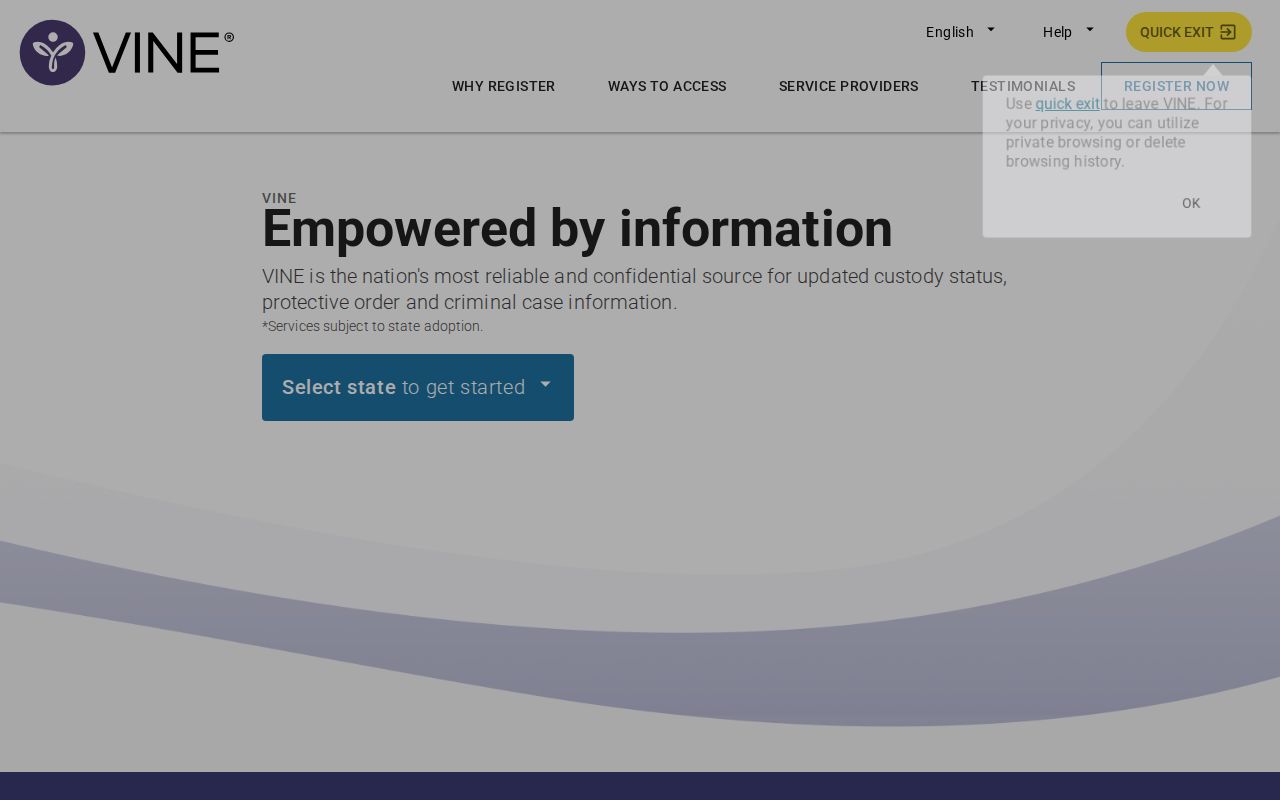
This screen is the starting point only. The matched agency record and its update time determine what the displayed event means.
Ector County Release Alert Fields
VINELink may show a custody status and a release-related event or date when the participating agency supplies them. The exact fields are not guaranteed. Do not promise a booking photo, release reason, destination, or permanent history unless the live record displays that item. A photo, if present, helps match identity but does not establish an exit.
| Displayed item | How to read it |
|---|---|
| Name and identifier | Match them with age, agency, and known case details before relying on the record. |
| Custody status | Read the exact words. “Not in custody” may still require a transfer or release record. |
| Agency or location | Shows which participating source supplied the event, not every possible custodian. |
| Event and date | May report release, transfer, escape, return, or another change supported by that source. |
| Update time | Shows system recency when displayed; it may trail physical movement. |
| Notification options | Lists the events and delivery methods available for that matched record. |
For Ector County jail custody, the strongest direct record is release paperwork held by the Sheriff's Identification and Records Division. Ask whether the exit was community release, bond, time served, transfer, federal pickup, or another disposition. For TDCJ, the public inmate search covers only people currently incarcerated in a TDCJ facility, so a missing state result is not a released-person archive.
Note: A transfer alert confirms movement between custodians, not freedom from custody or the legal end of a sentence.
Register Ector County Release Alerts
Registration should begin only after the person and agency match. Available events may include release, transfer, escape, return, death in custody, or another status change, depending on the source. Phone, text, and email choices can also vary. Enter the destination carefully because a mistyped number or address can defeat the alert.
- Open the correctly matched record and choose its notification or registration control.
- Select only the release or custody-change events offered by that source.
- Choose phone, text, or email and enter the delivery information.
- Create or confirm the requested phone PIN, or complete the text or email confirmation.
- Save the confirmation details and verify an eventual alert with the originating agency.
A telephone PIN can identify the registrant and acknowledge or stop repeated automated calls. The live prompt controls the exact process. TDCJ guidance says its automated phone notices continue until confirmed with the PIN, stopped through the portal, or resolved with Victim Services. It also says automated calls are not placed overnight, while electronic processing may continue. Those are state-system rules and should not be assumed for every county feed.
- Release event
- A source-reported exit from that custody record, subject to agency confirmation.
- Transfer event
- A move to another custodian or location; it is not community release.
- Discharge
- The legal end of a sentence or supervision, which is broader than leaving a jail or prison.
- PIN
- A code used to confirm identity or acknowledge some telephone notices.
Two Ector Release Notification Systems
Ector County creates a useful Texas-specific distinction. County VINE and TDCJ's Integrated Victim Services System or Victim Notification System are separate relationships. A county alert reflects a jail-fed event. The state system can cover post-conviction prison milestones such as parole review, a parole decision, release, an escape, a parole warrant, death, or sentence discharge for eligible registrants.
A person can move from Ector County Detention Center into TDCJ custody. The county registration does not automatically become the state registration. Following that full path may require one alert relationship with the participating county source and another with TDCJ. The correct source is the agency that holds the person at that stage.
TDCJ's IVSS user guide explains the state notification methods and PIN process. TDCJ Victim Services lists 800-848-4284 and victim.svc@tdcj.texas.gov for help with its system. Those contacts do not replace Ector County jail records staff.
Delivery method affects timing and detail. TDCJ guidance says email may contain more information than a text, while a mailed letter arrives after an electronic notice. A recipient should keep contact details current and should not assume that one method will duplicate every word sent through another. The event category selected during registration also matters. A prison release notice, parole-review update, warrant event, and sentence-discharge notice answer different questions.
County VINE can report a custody event supplied by a participating jail. TDCJ IVSS follows state post-conviction events. Neither replaces the court judgment or the custody agency's underlying record. If a person leaves Ector County on bond and later enters TDCJ after sentencing, the notification trail can have a gap unless the registrant follows the new custodian. Confirm the handoff, record the new identifier, and register through the system that serves the new stage.
The Texas Public Sex Offender Registry is yet another system. It can show a photograph and release-related status for the limited group required to register under Chapter 62, but it does not cover most released people. Registry absence can reflect scope, a restricted record, identity mismatch, or an ended duty. It cannot substitute for an Ector County VINELink match or an ECSO release record.
Confirm Ector County Release Events
Data entry and transmission can lag the physical event. An alert should trigger a direct check, not end it. For an Ector County Detention Center episode, call 432-335-3060 for immediate physical-custody context and request the named release paperwork from ID&R. That record can distinguish a true community exit from delivery to TDCJ, another county, a federal agency, ICE, or another authorized custodian.
For a Texas prison episode, use TDCJ classification, incarceration-history, Board, and Parole Division routes. The state online inmate search is updated on working days and is at least 24 hours old. After a person leaves current TDCJ incarceration, ask for incarceration history and actual release information rather than expecting a lasting released profile.
Federal prisoners are outside VINELink's core role. Use the BOP inmate locator for BOP custody, the ICE locator for current immigration detention, and USMS or the committing agency for a federal handoff from Ector County Correctional Center. Juvenile custody at Ector County Youth Center follows confidential juvenile court and probation channels.
When VINELink returns no match, check the spelling, identifier, selected jurisdiction, and current custodian before drawing a conclusion. A participant may not supply the event, a transfer may have shifted the record, or the data may not yet have refreshed. For an older county episode, the Ector court portal can preserve the case disposition after custody data changes. The Sheriff record remains the direct source for the physical county-jail exit.
County VINE, TDCJ IVSS or VNS, and federal locators follow different records. An Ector County jail alert is based on an event sent by the participating county source. It may report release, transfer, escape, return, or another offered change, but the available events depend on that source. TDCJ's notification system instead follows post-conviction prison and parole milestones for eligible registrants. Those notices can include parole review, a Board decision, prison release, a parole warrant, escape, death, or sentence discharge. Registering for the county feed does not automatically create a TDCJ registration when a person enters state custody.
BOP and ICE require separate checks. The BOP locator can cover a federal prison record and may show a release date for a person no longer in BOP custody. The ICE locator addresses current immigration detention and is not a complete release archive. A USMS handoff may also occur before BOP designation. None of these federal routes should be replaced with a county VINELink result.
Every electronic notice can trail the physical event because the custody agency must first enter and transmit its data. Keep the alert wording, update time, and registration confirmation. Then call the agency that supplied the event and ask whether the person left for the community, moved to supervision, transferred to another custodian, or reached final discharge.
Keep the confirmation number so registration problems can be traced.
Note: Save the event text and update time, then ask the originating office to confirm the physical exit and destination.