
Compare Ector Parole and Probation
The Texas Board of Pardons and Paroles decides whether an eligible state prisoner receives parole or mandatory supervision and handles revocation decisions. TDCJ Parole Division then supervises the person. Ector County Community Supervision and Corrections Department, commonly called Adult Probation, supervises a local court’s probation order. Its officers are judicial-district employees, not TDCJ parole officers.
| Record | Who orders it | Who supervises it | How to verify |
|---|---|---|---|
| Parole | Texas Board of Pardons and Paroles | TDCJ Parole Division | Board status route, then the Odessa District Parole Office |
| Mandatory supervision | Texas law and Board action where required | TDCJ Parole Division | TDCJ and Board records |
| Probation | Ector County court | Ector County CSCD | Court docket and Adult Probation |
- Parole
- Conditional release from prison while part of the sentence remains under state supervision.
- Probation
- A court sentence served in the community under local conditions.
- Mandatory supervision
- A Texas prison release framework based on calendar time, credits, eligibility, and required Board review.
- Discharge
- The legal end of the supervision or sentence obligation.
Verify Ector County Release Supervision
Begin with the case type rather than an address. A person who left the Ector County Detention Center on a local court order may have probation, pretrial conditions, or no supervision. A person leaving TDCJ on parole or mandatory supervision belongs to the state system. Residence in Odessa does not establish which one applies.
- Check the Ector court docket for the judgment and any community-supervision order.
- For a possible state release, use the Board’s person-specific review route or call 844-512-0461 before a vote.
- After an approval, call 512-406-5202 for release status. An approval code alone does not prove physical release.
- Confirm current parole supervision and office assignment with TDCJ Parole Division.
- Contact Ector Adult Probation only when the court record points to county community supervision.
Formal public information about a supervising office or officer, or a discharged client’s last-known public information, may be requested through TDCJ open records. Staff may limit details protected by law. Ask for the underlying record when a reporting duty, discharge, or transfer must be distinguished.
There is no verified statewide public, person-by-person probation lookup for an Ector County court case. The durable route is the clerk’s docket followed by the local department. A docket can show that community supervision was ordered and preserve later court action, while Adult Probation confirms the proper reporting office within lawful disclosure limits. For parole, the Board record answers the decision question and Parole Division answers the supervision question. One agency’s response should not fill a gap in the other system.
Ector County Supervision Offices
The TDCJ Region V directory places Ector County in the Odessa District Parole Office. The office handles confirmed parole and mandatory-supervision clients. Ector Adult Probation handles local court cases and publishes reporting forms. The county’s Adult Probation page also lists a separate parole telephone number, which helps show that the functions remain distinct.
Odessa District Parole Office
Director: Jennifer Humphrey
Address: 701 McDonald Street, Odessa, TX 79761
Phone: 432-550-0131
Fax: 432-550-0912
Ector County Adult Probation
Director: Laura Hall
Address: 312 N. Texas, Odessa, TX 79761
Phone: 432-498-4103
Fax: 432-498-4104
Hours: Monday through Friday, 8 a.m. to 4:45 p.m.
Call after the record identifies the agency. Neither office should be asked to interpret a case owned by the other system.
Check Ector County Parole Review
Ordinary Texas parole decisions use file review rather than a public, person-by-person hearing calendar. The Parole Division generally identifies a case about six months before initial eligibility and about four months before a later review. An institutional parole officer interviews the person and prepares material for a three-member panel. Two matching votes make the result final.
The Board’s review-results page gives the correct person-specific route. FI-1 means release when eligible. Other favorable FI codes may require a treatment program or another prerequisite. Denial codes can set a later review or require service to another point. Every code is a decision record, not proof that release processing finished.
Do not use the Board’s public-business meeting page as a calendar for a named person. The reviewed page carries old fiscal-year material and expressly says those quarterly meetings do not decide individual cases. Current public notices concern Board business, while the review-results channel and telephone line address a particular file. This difference keeps a public meeting date from being mistaken for a parole decision date.
The official capture below shows the person-specific status source used for Ector County parole questions.
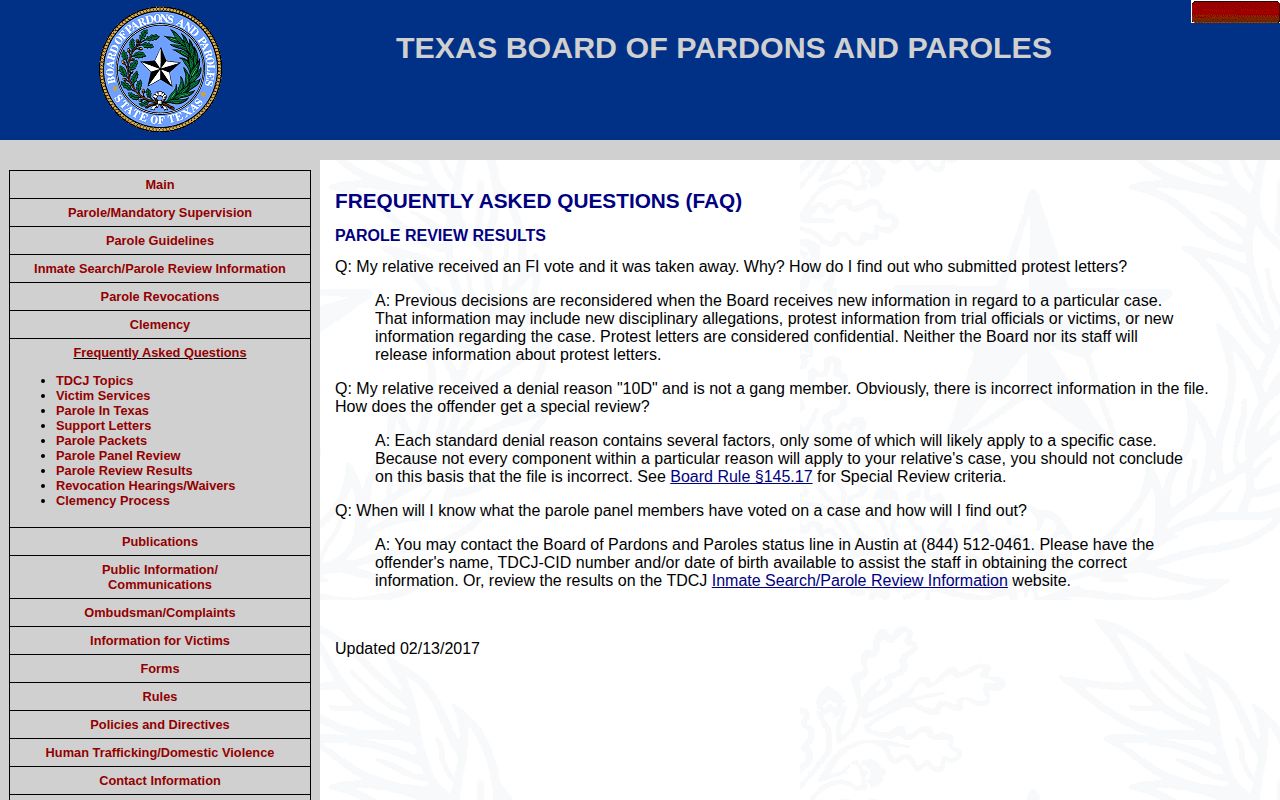
After approval, verify release status and then the assigned supervision office.
Ector County Parole Eligibility
Eligibility is only the first date when review may be possible. It is not a promise of approval. Texas Government Code Section 508.145 and offense-specific laws control the calculation. Cases covered by Code of Criminal Procedure Article 42A.054 commonly require one-half of the sentence or 30 calendar years, whichever is less, without good-time credit, and with a two-year minimum. Other offenses have different thresholds, so the offense and date must be checked against the current statute.
Good conduct time does not shorten the sentence imposed by the judge. Under Government Code Chapter 498, it is a privilege that may affect parole or mandatory-supervision eligibility and may be forfeited. Mandatory supervision also depends on exclusions and Board review under Sections 508.147 through 508.149. The displayed Inmate Release Date may move when credits, classification, Board action, or other legal events change.
Ector County Absconder Status
TDCJ defines an absconder as a releasee who stopped reporting and whose location is unknown. That status means supervision enforcement remains active. It does not erase the earlier release. The 24-hour anonymous tip line is 866-680-6667, but it is not a general lookup service for every person on parole.
A separate public search exists for absconding people who also fall within the covered sex-offender registry. It may show name, warrant date, release date, and last-known address. TDCJ warns that only fingerprint comparison confirms identity. Do not identify someone from a similar name or photograph alone.
Potential violations follow the Parole Division and Board process. A preliminary hearing addresses probable cause, while a revocation hearing considers the evidence and mitigation. The panel may continue supervision, impose a sanction or treatment placement, or revoke release and return the person to prison. Confirm the actual outcome through Board or Parole Division records.
Texas VINELink and state victim notification services serve another purpose. A county VINE event may report a jail-fed custody change from a participating agency. TDCJ IVSS or VNS can cover prison, parole review, release, warrant, and discharge milestones for eligible registrants. Neither stream replaces the formal supervision record, and a person moving from Ector jail into TDCJ may require separate registrations with both sources.
Ector Release Property Approval
ECSO’s confined-person rules allow non-clothing property to be released with the inmate’s approval. Selective property release needs Administration approval, while funds may be released to immediate family with approval. The county also publishes a Prisoner’s Property Release Form.
Those rules deal with property during confinement. They do not describe final discharge or prove that a person has entered parole or probation. The jail should confirm how remaining property is returned at exit, while the proper supervising office confirms the later reporting obligation.
Confirm Ector County Supervision Discharge
Leaving physical custody is not the same as completing a sentence. Parole and mandatory supervision usually leave a balance under state supervision. Maximum expiration is the sentence endpoint in TDCJ’s calculation, while a discharge record confirms that the legal obligation ended. Probation ends according to the court’s order and any later action in the case.
Use a court docket for county probation and TDCJ or Board records for state supervision. Texas VINELink may carry custody events from a participating agency, but it does not establish the legal end of parole or probation. The Ector County released inmate search explains how to pair a supervision record with the original jail release paperwork.
Write down the agency, number called, date, and exact terms used when staff provides a status. A phone response is a useful lead, but the formal record is stronger when the difference between active supervision, a pending warrant, and full discharge matters. Protected details may be withheld, and the absence of a public lookup result should never be turned into a claim that supervision ended.
A state discharge record differs from county jail release paperwork. The jail record documents departure from local physical custody. A TDCJ or Board record shows whether a prison sentence or state supervision obligation continued after that departure. Likewise, a court’s probation termination order addresses local supervision. Match the document to the legal event before describing the person as fully discharged.